
The Ultimate Melbourne Wedding Timeline: A Real-World Guide from 600+ Weddings
- Josh Sperring
- Aug 6
- 18 min read
Planning your wedding timeline? Here's what I've learned after 600+ weddings.
One of the most common questions I get from couples is:
"What time should everything happen on our wedding day?"
It's a great question, but after performing at more than 600 weddings across Melbourne, the Yarra Valley, Mornington Peninsula and beyond, I've realised there's actually a better one to ask...
"How do we make the whole day feel relaxed, fun and effortless?"
Because the truth is, a great wedding isn't remembered because the speeches started at exactly 6:47pm.
It's remembered because everyone felt relaxed, the day flowed naturally, there was plenty of time to spend with family and friends, and the dance floor was packed at the end of the night.
I've seen weddings with almost identical timelines feel completely different simply because one had room to breathe and the other felt rushed from start to finish.
So rather than giving you a generic run sheet with arbitrary times, I want to walk you through what I've found works best after hundreds of real weddings. I'll explain not just what happens throughout the day, but why it works.
Whether you're planning a winery wedding in the Yarra Valley, a beach wedding on the Mornington Peninsula or a reception in the Melbourne CBD, these principles apply almost everywhere.
The Golden Rule: Aim for a Seven-Hour Wedding
If I could give every couple just one piece of timeline advice, it would be this:
Aim for around seven hours from your guests arriving until the reception finishes.
In my experience, that's the sweet spot.
Six-hour weddings often feel rushed.
By the time you've had your ceremony, taken photos, enjoyed dinner, listened to speeches and had your first dance, there's very little time left for simply enjoying the party.
On the other hand, weddings that stretch beyond eight hours can start to lose energy.
Guests naturally get tired, older family members head home earlier, and even the biggest party crowds begin to slow down after a full day of celebrating.
Seven hours gives you enough time to enjoy every part of the day without ever feeling like you're racing the clock.
As a general guide:
6 hours – Can feel rushed, particularly if dancing is important to you.
7 hours – The sweet spot for most weddings.
8 hours – Usually the maximum before the day starts feeling long.
Of course, every wedding is different. If you're planning a relaxed cocktail-style reception, your timeline might look a little different to a formal three-course dinner. But regardless of the style, giving your day enough breathing room is one of the best decisions you can make.
Josh's Tip: Don't try to squeeze too much into your wedding day. Leave space for conversations, unexpected moments and simply taking it all in. The best weddings never feel rushed.
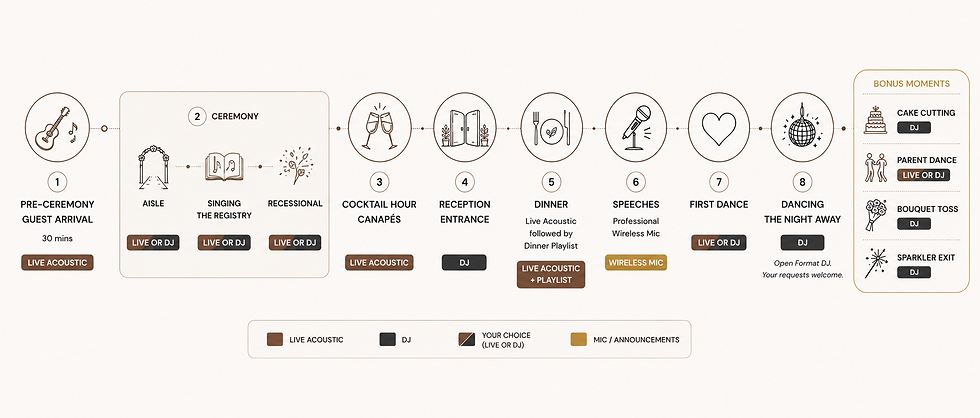
Summer vs Winter Weddings
One of the biggest factors that affects your timeline is the time of year.
In summer, the longer daylight hours give you much more flexibility. A ceremony starting around 4:00–4:30pm often works beautifully, with receptions finishing around 11:00–11:30pm.
Winter is a little different.
Because the sun sets much earlier, I generally recommend bringing everything forward.
A 3:00pm ceremony with a 10:00pm finish allows you to make the most of the natural light before sunset while still enjoying a full evening reception.
That said, don't rely too heavily on the calendar.
Melbourne weather has a habit of doing whatever it wants.
I've seen beautiful sunny winter weddings and I've seen summer weddings where everyone ends up indoors because of heavy rain.
The key isn't trying to predict the weather—it's building enough flexibility into your timeline that whatever happens, the day still flows smoothly.
Before the Ceremony
The atmosphere of your wedding doesn't begin when you walk down the aisle.
It begins the moment your first guests arrive.
I recommend asking guests to arrive around 30 minutes before the ceremony starts.
Some guests will inevitably run a little late, but giving everyone a 30-minute arrival window dramatically reduces the chance of people walking in halfway through your vows.
It's also the perfect time to create the atmosphere you want for the day.
Having live acoustic music or carefully chosen background music playing as guests arrive immediately sets the tone. Rather than people standing around waiting, the celebration has already begun.
If your venue allows it, offering guests a drink while they mingle before the ceremony is another lovely touch.
Around 10 minutes before the ceremony, guests should begin taking their seats so everything is calm and ready to begin on time.
It might seem like a small detail, but a relaxed start creates a relaxed day.
The Ceremony
The ceremony is obviously the most important part of your wedding day. It's the reason everyone has gathered in the first place.
That said, one of the biggest surprises for many couples is that shorter is often better.
In my experience, around 30 minutes is the sweet spot.
That's enough time for your celebrant to tell your story, share a few laughs, include meaningful vows and make the ceremony feel personal, without it becoming so long that guests start losing concentration.
Remember, your guests have probably been standing or sitting outside, many have travelled a long way to celebrate with you, and everyone is excited for the celebrations still to come. Keeping the ceremony engaging and well-paced helps maintain that excitement right through the rest of the day.
Of course, every ceremony is different. Cultural traditions, religious ceremonies or personal touches may naturally make yours a little longer, and that's perfectly okay. The important thing is making sure every part of the ceremony feels intentional.
Josh's Tip: The ceremonies people remember most aren't necessarily the longest—they're the ones that feel genuine. A few heartfelt moments and some laughter will leave a much bigger impression than trying to squeeze in every story you've ever shared together.
Cocktail Hour: More Important Than Most Couples Realise
Once the ceremony finishes, it's time for one of my favourite parts of the day.
Cocktail hour.
While it might feel like a gap between the ceremony and reception, it's actually doing several important jobs at once.
It's your chance to disappear for family photos, bridal party photos and those beautiful couple portraits while your guests relax with a drink, enjoy canapés and start getting to know each other.
Done well, cocktail hour feels effortless.
Done poorly, it can feel like everyone is waiting around wondering what's happening.
The sweet spot is 60 to 90 minutes.
Any shorter, and your photographer can end up feeling rushed trying to fit in all the important photos.
Any longer, and guests naturally start becoming restless and wondering when they'll be invited into the reception.
It's a balancing act.
The good news is that most experienced photographers and venues are very good at working together to make this part of the day run smoothly.
Don't Feel Guilty About Leaving Your Guests
One question I hear all the time is:
"Will everyone be annoyed that we're gone taking photos?"
The answer is almost always no.
As long as your guests have something to eat, something to drink and people to chat with, they're generally more than happy catching up while you capture photos you'll treasure forever.
In fact, cocktail hour is often the first chance that family and friends who haven't seen each other for years get to properly catch up.
So don't feel guilty about stepping away for your portraits.
It's one of the few quiet moments you'll get together all day.
Golden Hour Photos Are Worth It
If your photographer suggests slipping away for 10–15 minutes just before sunset, I'd almost always recommend doing it.
Golden hour creates some of the most beautiful light you'll see all day, and those photos often become favourites.
The key is timing.
Heading out briefly before sunset usually has very little impact on your reception.
Heading out once the dance floor is pumping is a different story.
When the couple disappear during peak dancing, the energy in the room often disappears with them. Guests naturally want to be where you are, and it can be surprisingly difficult to rebuild that momentum once everyone returns.
If you're planning sunset photos, try to schedule them before the dance floor officially opens.
It's a much smoother flow for everyone.
Josh's Tip: If your photographer needs you for golden hour photos, absolutely do it—but avoid disappearing once the dance floor is in full swing. Your guests will naturally follow your energy throughout the night.
Before We Head Into the Reception...
By now, you've:
Married your favourite person.
Celebrated with family and friends.
Captured your formal photos.
Had a chance to catch your breath.
Now it's time for the reception—the part of the day where I see the biggest difference between weddings that simply run on time and weddings that feel unforgettable.
And it all starts with one surprisingly overlooked moment: the reception entrance.
The Reception: Setting the Tone for the Night
As exciting as the ceremony is, the reception is where the celebrations really begin.
Your guests have had a chance to relax during cocktail hour, everyone's found their seats, and now it's time to kick off the evening.
While every wedding is different, I've found that the best receptions don't feel like a series of separate events. Instead, each part naturally flows into the next.
That's what keeps the energy high and the evening feeling effortless.
The Grand Entrance
Your reception entrance is the first big celebration of the night, so don't be afraid to have some fun with it.
Whether it's a high-energy song, guests waving their napkins in the air or everyone clapping along, this is your moment to walk into a room full of the people who are genuinely excited to celebrate with you.
The style of your entrance should reflect you.
If you've got a crowd of big party lovers, you might even head straight into a short 10–15 minute dance set before dinner. This can be a fantastic way to get everyone's energy up early and create a memorable start to the evening.
For most weddings, though, a fun entrance song followed by a quick cake cutting works beautifully.
Cake Cutting: Keep It Simple
The cake cutting is one of the quickest formalities of the day.
In reality, it usually takes less than a minute.
That's exactly why I recommend grouping it together with other formalities, rather than making everyone stop what they're are doing later in the evening for such a short moment.
One of my favourite ways to do it is immediately after your reception entrance.
Your MC already has everyone's attention, everyone's standing, cameras are ready, and you can tick off another important part of the day without interrupting the flow later on.
It's a small adjustment, but it makes the whole evening feel much smoother.
Josh's Tip: Whenever possible, bundle your shorter formalities together. The fewer times you have to stop the room and regain everyone's attention, the more natural the evening will feel.
Dinner: More Than Just Eating
One question couples often ask is:
"Why does dinner take so long?"
The answer is that dinner isn't just dinner.
It's also when a lot of the important moments happen.
Entrée needs to be served.
Plates need to be cleared.
Mains need to be prepared and served.
Guests are chatting and catching up.
The venue staff are quietly working behind the scenes.
And in between all of that...
...you've got speeches.
For most weddings, around two hours is ideal for the dinner portion of the evening.
That might sound like a long time on paper, but once everything starts happening, it passes surprisingly quickly.
A typical reception might see entrée served around 6:00–6:30pm, with dinner wrapping up somewhere around 8:00–8:30pm, depending on your ceremony time.
Trying to rush dinner often creates unnecessary stress for both your venue staff and your guests.
Giving everyone enough time to relax and enjoy the meal creates a much nicer atmosphere before the dancing begins.
Speeches: Leave People Wanting More
I've heard hundreds of wedding speeches over the years.
Some have had the entire room crying with laughter.
Some have had the entire room crying...
...because they were still going after half an hour.
The truth is, guests genuinely enjoy speeches.
They love hearing funny stories, heartfelt memories and learning more about the couple.
What they don't enjoy is when speeches drag on for so long that everyone starts checking their watches and wondering when the party is going to start.
For most weddings, I think around 20 minutes in total is the sweet spot.
That usually works out to four or five speeches, split into two shorter sections.
For example:
One group of speeches between entrée and mains.
A second group after mains.
Splitting them up keeps guests engaged, gives everyone something to look forward to throughout dinner, and avoids one long block that feels never-ending.
As a general guide, I'd aim for each speaker to keep things to around three to five minutes.
It's amazing how much you can say in that time.
Josh's Tip: The best speeches are the ones that leave people wishing they'd gone for another minute—not the ones where everyone is secretly hoping they'll finish soon.
Parent Dances
If you're including a father-daughter dance, mother-son dance or another special family dance, there's no strict rule about where it has to go.
Unlike your first dance, it doesn't necessarily need to lead directly into the dance floor.
One of my favourite places to include it is after the father of the bride's speech, before the main course is served.
It creates a lovely emotional moment while everyone's already focused on the formalities, without interrupting the energy once dancing has begun later in the evening.
Of course, every wedding is different, and if it flows better immediately before or after your first dance, that can work beautifully too.
The key is simply making sure it feels like a natural part of the evening rather than something that stops the momentum.
The First Dance: The Most Important Transition of the Night
For many couples, the first dance is simply a tradition.
It's the moment everyone gathers around, you share your first dance as a married couple, and then... something else happens.
But after more than 600 weddings, I've come to see the first dance a little differently.
I believe it's the single most important transition of the entire reception.
Done well, it creates a natural bridge between the formal part of the evening and the biggest celebration of the night.
Done poorly, it can make it much harder to build momentum on the dance floor.
Why the First Dance Works So Well
Think about what's happening at that moment.
Every guest is already standing around the dance floor.
Everyone's attention is focused on you.
The room is quiet.
People are smiling, watching and ready for what's next.
It's the perfect opportunity to turn a room full of spectators into a room full of dancers.
That's why I almost always recommend making your first dance the last major formality before the dance floor officially opens.
Rather than ending the dance, sitting everyone back down and trying to convince people to dance again twenty minutes later, you can use the emotion and excitement of that moment to naturally invite everyone onto the dance floor.
It's one of the easiest ways to create instant energy.
A Simple Transition That Works Beautifully
One of my favourite ways to start the dance floor is also one of the simplest.
As your first dance begins, your MC invites all of your guests to gather around the dance floor and form a circle around you.
It creates a beautiful atmosphere.
Your closest family and friends are right there with you.
The room feels connected.
Then, towards the end of your song—or as soon as it finishes—the MC invites everyone to join you on the dance floor.
There's no awkward pause.
No empty dance floor.
No trying to convince people to leave their seats.
The party has already started.
Sometimes guests join in during the final chorus. Sometimes they wait until the song finishes. Either way, it feels completely natural because everyone is already there.
Josh's Tip: If you're hoping for a packed dance floor, don't think of your first dance as a standalone moment. Think of it as the beginning of the party.
Keep the Momentum Going
Once the dance floor is full, your goal changes.
You're no longer trying to get people dancing.
You're trying to keep them dancing.
This is where I often see good dance floors lose momentum.
Not because the music isn't working...
...but because the evening gets interrupted.
Avoid Stopping a Great Dance Floor
Imagine you've got 70 people on the dance floor.
Everyone's singing along.
The energy is building.
Then someone grabs the microphone.
The music stops.
Guests are asked to leave the dance floor for another formality.
Five minutes later, the music starts again.
You haven't just paused the party—you've asked everyone to rebuild the energy from scratch.
Sometimes it works.
Often, it doesn't.
That's why I generally recommend avoiding formalities once dancing is underway unless they're absolutely necessary.
Bouquet Tosses, Dessert & Other Interruptions
That doesn't mean you can't include them.
It just means timing matters.
Take the bouquet toss, for example.
If the dance floor naturally starts to slow down after an hour or so, it's the perfect opportunity to gather everyone back together.
Instead of interrupting great momentum, you're using the bouquet toss to create fresh excitement and bring people back onto the dance floor.
On the other hand, if your dance floor is absolutely packed all night, I'd be tempted to leave the bouquet toss until just before your farewell.
Why stop something that's working?
The same goes for dessert buffets, dessert carts and other late-night food stations.
If they open right in the middle of peak dancing, it's amazing how quickly a full dance floor can empty.
Guests wander off for dessert...
Then they start chatting...
Before you know it, that incredible energy has disappeared.
If possible, schedule dessert before dancing begins or later in the evening when the dance floor is naturally starting to wind down.
Small timing decisions like these can make a surprisingly big difference to the atmosphere of your reception.
What About Night-Time Photos?
Night-time portraits can look incredible.
But just like dessert or bouquet tosses, timing is everything.
If you leave the dance floor while it's at its busiest, there's a good chance your guests will follow your lead.
After all, you're the reason everyone is there.
If your photographer would like a few night-time portraits, try to keep them quick, or better yet, capture them before the dance floor reaches its peak.
Your guests will still be there when you get back—but the momentum you've built may not be.
How Long Should Dancing Go For?
There isn't a perfect answer.
It depends entirely on your guests.
If you've got a crowd that loves a party, two to three hours of dancing is usually ideal.
If dancing isn't the main focus of your wedding, around an hour and a half may be plenty.
Personally, I'd much rather see two hours of an absolutely packed dance floor than three hours where the energy slowly fades and people begin drifting home.
The goal isn't simply to have dancing for as long as possible.
It's to finish the night wishing you had one more song.
Josh's Tip: A great dance floor isn't measured by how many hours it lasts. It's measured by the smiles, the laughter, the people singing at the top of their lungs, and everyone wishing the night didn't have to end. Read more here on how to get a packed dance floor>>>>>>
The Biggest Wedding Timeline Mistakes (And How to Avoid Them)
The good news is that most weddings run really well.
Experienced venues, photographers, celebrants and suppliers do an incredible job of keeping everything on track, so major timeline disasters are actually quite rare.
That said, after more than 600 weddings, there are a handful of mistakes I see come up time and time again.
The good news?
They're all easy to avoid once you know what to look for.
1. Trying to Fit Too Much Into One Day
This is probably the biggest mistake I see.
Couples spend months planning every little detail and naturally want to include everything.
Extra photos.
Extra traditions.
Extra games.
Extra formalities.
Extra surprises.
Individually, none of these things are a problem.
Usually it's the time you actually get to enjoy your wedding.
One of the things couples tell me most often afterwards is how quickly the day disappeared.
If your timeline is packed from beginning to end, you can spend the whole day rushing from one thing to the next without ever getting a chance to stop and take it all in.
Leave yourself some breathing room.
Future you will be grateful.
2. Letting Speeches Go Too Long
Guests genuinely enjoy speeches.
They want to laugh.
They want to hear heartfelt stories.
They want to celebrate with you.
What they don't want is forty-five minutes of speeches when dinner has gone cold and everyone is wondering when the party is going to start.
Keeping speeches short doesn't make them less meaningful.
In fact, it often has the opposite effect.
People remember the speeches that leave them wanting more.
Not the ones they're relieved to see finish.
3. Stopping a Full Dance Floor
You've finally done it.
The dance floor is packed.
People are singing.
Grandparents are dancing with teenagers.
Your shy uncle has somehow become the life of the party.
Then...
The music stops.
Everyone is asked to leave the dance floor for another formality.
Moments like these can completely change the energy of the night.
Whenever possible, try to group formalities together before dancing begins, or save them for a natural lull later in the evening.
If the dance floor is working, let it work.
4. Taking Guests Away From the Party
Dessert buffets.
Late-night food stations.
Coffee carts.
Night-time photos.
None of these are bad ideas.
The issue is simply when they happen.
If you give guests a reason to leave a packed dance floor during its busiest moment, many of them won't come straight back.
Instead, they'll grab dessert.
Catch up with friends.
Sit down for a while.
Before you know it, the momentum you've spent all night building has disappeared.
Whenever possible, schedule these moments either before dancing starts or later in the evening when the energy is naturally beginning to slow.
5. Waiting Too Long to Make the Weather Call
If you're planning an outdoor ceremony, this one's important.
Melbourne weather can change quickly.
Luckily, weather forecasts are pretty reliable these days.
If rain looks likely, I'd always encourage couples and venues to make the decision to move indoors at least 30 minutes before the ceremony—ideally an hour beforehand.
Leaving the decision until the last minute puts unnecessary pressure on everyone involved.
Venue staff suddenly have to move or dry chairs.
Florists need to relocate arrangements.
Celebrants and musicians need to move equipment.
Guests are left wondering where they're meant to be.
Making the call early gives everyone time to reset calmly and helps ensure your ceremony still starts on time.
Remember...
Your guests will remember a relaxed ceremony far more than they'll remember whether it happened inside or outside.
Josh's Tip: I've never heard a couple say, "I wish we'd waited another ten minutes before deciding to move indoors." Making the call early almost always results in a calmer, more enjoyable start to the day.
6. Forgetting to Be Present
This isn't really a timeline mistake.
It's a mindset mistake.
It's so easy to spend months worrying about every tiny detail.
The flowers.
The table settings.
The seating chart.
The napkin colours.
The timings.
The weather.
And then, before you know it...
The wedding is over.
One of the biggest things I've learned after hundreds of weddings is this:
The couples who enjoy their day the most aren't the ones whose wedding is "perfect."
They're the ones who stay present.
Take a moment during the ceremony to look around at everyone who's there for you.
Step back during cocktail hour and take it all in.
Stand together during your reception and look across the room while everyone's laughing over dinner.
Spend five seconds during the dance floor simply watching your favourite people celebrate with you.
Those are the moments you'll remember.
Not whether your speeches started five minutes late.
Not whether the napkins matched the flowers.
Not whether the cake cutting happened before or after entrée.
You'll remember how the day felt.
And that's what really matters.
Your Timeline Should Work for You—Not the Other Way Around
It's easy to become so focused on creating the "perfect" wedding timeline that you forget what the timeline is actually there to do.
Its job isn't to control your day.
Its job is to support it.
Some moments will run a little early.
Others might run a few minutes late.
Someone will probably disappear when it's time for family photos.
A speech might go a minute longer than planned.
None of those things matter.
The best wedding timelines aren't rigid schedules.
They're flexible guides that leave room for the unexpected.
Because some of the most memorable moments of a wedding are the ones you could never have planned.
Sample Wedding Timelines
Every wedding is different, but these examples should give you a good starting point. Remember, these aren't rigid schedules—they're simply examples of timelines that generally flow well.
Example 1: Summer Wedding (The Classic)
4:00pm – Guests arrive
4:30pm – Ceremony
5:00pm – Cocktail hour & photos
6:30pm – Reception entrance
6:35pm – Cake cutting
6:45pm – Entrée
7:15pm – First round of speeches
7:30pm – Main course
8:00pm – Final speeches
8:15pm – Parent dance (optional)
8:20pm – First dance
8:25pm – Dance floor opens
10:45pm – Bouquet toss (optional)
11:00pm – Farewell
11:30pm – Finish
Example 2: Winter Wedding
2:30pm – Guests arrive
3:00pm – Ceremony
3:30pm – Cocktail hour & photos
5:00pm – Reception entrance
5:05pm – Cake cutting
5:15pm – Entrée
5:45pm – First speeches
6:00pm – Main course
6:45pm – Final speeches
7:00pm – First dance
7:05pm – Dance floor opens
9:45pm – Farewell
10:00pm – Finish
Example 3: Cocktail-Style Wedding
Cocktail weddings usually have fewer formalities and more time for mingling, so they can often move a little quicker.
The key is making sure there are still natural moments for speeches and your first dance without interrupting the relaxed atmosphere.
Example 4: Church Ceremony + Separate Reception
These weddings often have a larger gap between ceremony and reception while guests travel between venues.
If that's the case, think about providing guests with suggestions for nearby cafés, bars or attractions, or organise a relaxed drinks reception before everyone heads into the evening celebration.
Frequently Asked Questions
How long should a wedding reception be?
Around five hours is ideal for most receptions, allowing enough time for dinner, speeches and around two to three hours of dancing.
How long should speeches be?
Around 20 minutes in total is a great target.
Split them into two shorter sessions if possible to keep guests engaged.
When should the first dance happen?
In most cases, I'd recommend making it the final major formality before opening the dance floor.
It's one of the easiest ways to create momentum that carries into the rest of the night.
Should we do golden hour photos?
Absolutely.
Just try to schedule them before the dance floor is in full swing.
How long should cocktail hour be?
Generally 60–90 minutes.
This gives your photographer enough time while keeping guests relaxed and entertained.
What happens if we're running behind schedule?
Don't panic.
Almost every wedding runs a few minutes early or late at some point.
An experienced venue and supplier team will usually make small adjustments throughout the day without your guests even noticing.
What's the biggest piece of advice you'd give couples?
Leave room to breathe.
The best weddings don't feel rushed.
They feel relaxed.
Final Thoughts
After more than 600 weddings, there's one thing I'm absolutely certain of.
The weddings people talk about for years afterwards aren't the ones that ran exactly to schedule.
They're the ones where everyone felt relaxed.
Where the laughter was genuine.
Where family and friends had time to connect.
Where the dance floor was full.
And where the couple actually got to enjoy every moment instead of worrying about what was happening next.
Your timeline isn't there to control your wedding.
It's there to give your day enough structure that you can stop thinking about it altogether.
Because once the music starts, you're married, and all of your favourite people are in the one room...
that's when the real memories begin.
Planning your wedding in Melbourne?
If you're looking for someone who can provide live acoustic music, DJ entertainment and help your day flow seamlessly from ceremony through to the final song, I'd love to hear about your plans.
You can check my availability, explore my packages or simply get in touch for a relaxed chat—I'm always happy to help, even if it's just answering a few questions about your timeline.
Reviewed and updated by Josh Sperring. Josh is the founder of Sperring Entertainment and has performed at over 600 Melbourne weddings. Read more about Josh >>>
Last updated: August 2026


Comments